
Pomorska Street Krakow
(Dom Śląski)
A Place Marked by Two Totalitarian Regimes
Located at 2 Pomorska Street in Kraków, the building known as Dom Śląski holds one of the darkest legacies in the city. During the Nazi occupation (1939–1945), it served as the headquarters of the Gestapo, the German secret police responsible for crushing resistance and persecuting anyone suspected of anti-German activity. The building housed offices and basement prison cells where members of the Polish underground, clergy, intellectuals, and ordinary citizens were interrogated, tortured, and often executed. Thousands of Kraków’s residents passed through its corridors; for many, it was the last stop before being sent to concentration camps such as Auschwitz or Płaszów.
After the war, from 1945 to 1956, the same site was taken over by the communist security service (Urząd Bezpieczeństwa), which continued the cycle of fear under a different ideology. Former Gestapo cells once again echoed with cries of prisoners — this time soldiers of the Polish Home Army, political opponents, and civilians accused of disloyalty. Pomorska Street thus became a rare and haunting symbol of two totalitarian systems using the same walls for oppression. Its dual legacy makes it one of the most significant historical sites in post-war Poland. To understand this place more deeply, it is worth tracing the story of the building itself – from its original purpose to the horrors that unfolded within its walls.
History of the Building
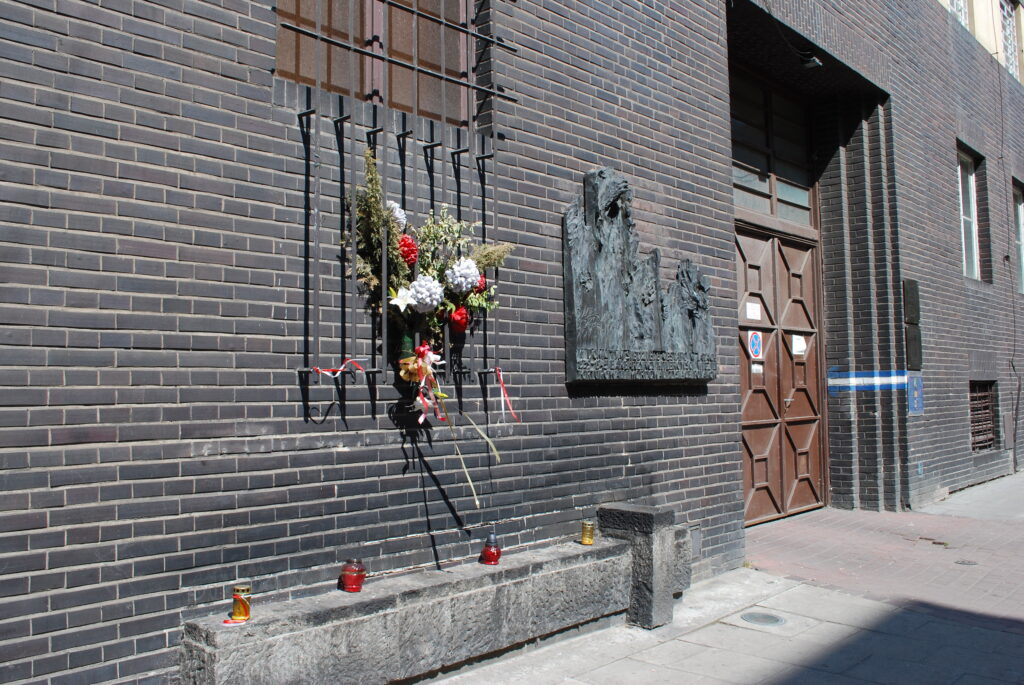
Photo by Delimata, CC BY-SA 4.0
Pomorska Street (Ulica Pomorska), former Gestapo headquarters in Kraków, now part of the Historical Museum of the City of Kraków (Dom Śląski).
Photo by Delimata, CC BY-SA 4.0
Dom Śląski was erected in the late 1930s as a residence and cultural centre for students from Upper Silesia studying in Kraków. When the Germans occupied the city in 1939, they seized the property and transformed it into the Gestapo’s regional command centre (Staatspolizeileitstelle Krakau). The cellars were adapted into interrogation rooms and prison cells, where prisoners were held before transfer to Montelupich Prison or execution in the nearby Płaszów camp.
The walls of the underground cells still bear authentic inscriptions made by the prisoners — names, dates, short messages, and prayers scratched or written in pencil. These silent traces form one of the most moving parts of the current exhibition.
After 1945, the building was taken over by the Urząd Bezpieczeństwa (Security Office), and political prisoners were once again detained here. For many families, Pomorska Street became synonymous with disappearance and fear.
The Exhibition: “People of Kraków in Times of Terror 1939–1945–1956”
Today, the site functions as part of the Museum of Krakow and forms a key point on the city’s Memory Trail. The permanent exhibition, curated by Grzegorz Jeżowski, tells the story of ordinary citizens – Poles and Jews, adults and children – who lived, fought, or suffered under two totalitarian regimes.
The display combines personal stories, documents, photographs, and multimedia presentations. Visitors can enter the preserved Gestapo cells, hear authentic testimonies of survivors, and explore an electronic database of victims. The exhibition powerfully juxtaposes public history with private memory, showing how terror became an everyday experience.
Practical Information
Address: Pomorska 2, 30-039 Kraków
Opening hours: Wednesday – Sunday 10:00 – 17:00 (last entry 16:30)
Closed: Monday, Tuesday, and public holidays
Tickets: Regular 20 PLN, Reduced 15 PLN, Family 40 PLN, Free entry on Wednesdays
Accessibility: Ground floor accessible for visitors with limited mobility
Recommended visit time: 30–60 minutes
Nearby sites: National Museum in Kraków (Main Building), Józef Piłsudski House, Jordan Park, Old Town and Main Market Square, Nowy Kleparz Market